

How to: high resolution
Resolving powers exceeding 50 (1/FWHMz)
-
Large trumpet ratios for flow acceleration after laminarization
-
High sheath to flow ratios
-
Excellent concentricity
-
Surface ultrapolishing
-
Sloped DMA channel geometry
-
Precision latheworks
-
Stainless and PEEK on wetted parts
-
... and much more
Meet the performance team
This is our dream team of features key to achieve high resolution.

Ultrapolishing
See yourself!

Reproducibility
All conical fittings

Flow acceleration
Reynolds who?

All stainless
the rest is PEEK

Concentricity
At every corner
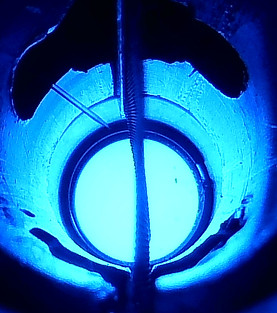
Bipolar electrospray
Twice the fun
History of high resolution ES-DMA
NanoEngineering's technology originated from the laboratory of Professor Juan Fernández de la Mora at Yale University.
The pursuit of higher resolving powers in differential mobility analysis faced a fundamental challenge: how do you verify the performance of an instrument when no sufficiently monodisperse reference particles exist?
The answer came through Professor de la Mora's invention of the bipolar electrospray ionization source, capable of generating chemically defined ion clusters with extraordinary precision. This advance provided the standards needed to push DMA technology to its limits.
Viruses later extended this capability into larger size ranges, offering some of the narrowest mobility distributions found in nature.
Together, these innovations helped define the state of the art in high-resolution differential mobility analysis and provide the technical foundation for NanoEngineering's instruments today.
Custom Method Development
We work with researchers and industry partners on advanced characterization projects, including tandem DMA experiments, post-fractionation particle collection, and other custom analytical workflows.
Contact